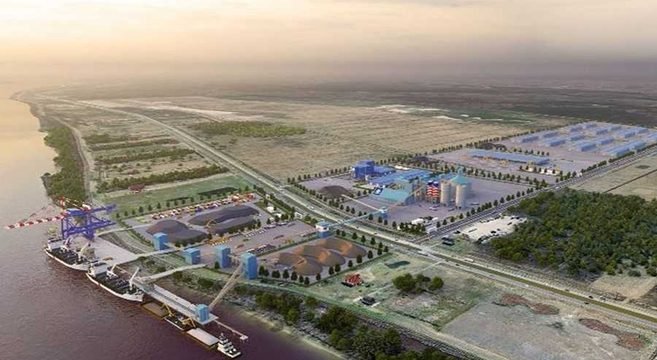
Four companies are investing a combined $294.1 million to build a 300-acre industrial campus in Plaquemines Parish, pairing a Mississippi River marine terminal with three manufacturing plants that will produce construction materials. American Gulf Marine Terminals, LA Cement Works, Cemtech USA, and LA Gypsum announced the project November 19 with Louisiana Economic Development. Construction is set to start in the fourth quarter of 2026 with the marine terminal and a precast concrete plant, with the remaining phases continuing through 2028.
American Gulf Marine Terminals will build, own, and operate the campus’s multipurpose terminal, called AGM-Point Celeste, at Mississippi River Mile Marker 52. The terminal is designed to take both inland and oceangoing vessels, bringing in raw materials for the on-site plants and shipping finished products to markets across Louisiana and the Gulf Coast.
The three plants are a cement grinding facility from LA Cement Works, a gypsum wallboard plant from LA Gypsum, and a precast concrete operation from Cemtech USA. The precast plant will make piles, blocks, and other engineered components for industrial, commercial, marine, and infrastructure work, and will also support the casting of concrete buildings. Putting the plants beside their own terminal is meant to create an integrated supply chain for construction materials, with river access, manufacturing, and regional distribution on one site.
The companies expect to create 250 direct jobs averaging $70,000 a year, and LED estimates another 281 indirect jobs, for 531 potential positions in total. To win the project, the state offered workforce recruitment and training through its FastStart program and a $3.5 million performance-based grant for site and infrastructure work. The project may also qualify for the Industrial Tax Exemption Program, which generally provides an 80 percent property tax abatement for up to 10 years on eligible manufacturing property, though that would not necessarily cover the full investment.
The campus adds to a run of industrial activity across the region’s river parishes. T. Parker Host committed $50 million last month to expand Avondale Global Gateway in Jefferson Parish, and the Port of New Orleans’ planned Louisiana International Terminal in St. Bernard Parish has been cited by lenders and brokers as a driver of future demand for warehouse and distribution space.
For the metro construction market, a local source of cement, wallboard, and precast concrete could matter as much as the jobs. Building costs have been a recurring constraint on development across Greater New Orleans this year, with insurance, financing, and materials pricing cited at the October forecast symposium as reasons projects struggle to pencil.
about the author: CSB Staff


